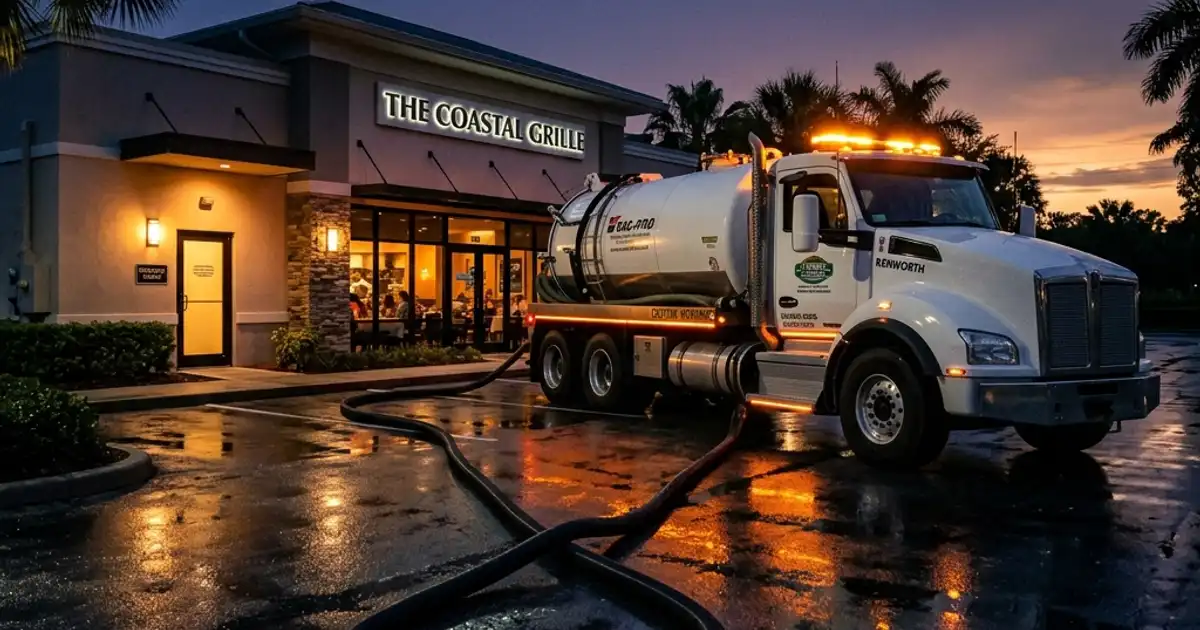
Emergency Grease Trap Overflow: What to Do
If your grease trap or interceptor is overflowing right now, stop reading and take action: shut off water to the affected fixtures, contain the spill with absorbent materials, and call an emergency grease trap service company immediately. A grease overflow is a health hazard and potential environmental violation that requires fast response.
Once the immediate crisis is managed, this guide walks you through the complete response process — from containment to cleanup to prevention.
Immediate Steps When Overflow Happens
Within the first 5 minutes:
-
Stop the flow. Turn off all water running to fixtures connected to the overflowing trap. If you can't isolate the fixtures, shut off the main water supply to the kitchen area.
-
Contain the spill. Use absorbent materials — kitty litter, absorbent pads, or even flour in an emergency — to prevent grease from spreading to dining areas, parking lots, or storm drains. Grease must not enter storm drains — this is an environmental violation.
-
Block floor drains. If grease is flowing toward floor drains that lead to the storm sewer (not the sanitary sewer), block them immediately with rags, towels, or drain covers.
-
Evacuate the immediate area. Move staff and customers away from the spill zone. Grease on floors is an extreme slip hazard, and raw grease waste has bacteria and odors that pose health risks.
-
Ventilate the space. Open doors and windows near the overflow. Grease trap gases (hydrogen sulfide) can be dangerous in enclosed spaces.
Who to Call — In Order
Call 1: Emergency grease trap service Find a 24/7 emergency service provider in your area. Many grease trap companies offer same-day emergency pump-outs. Explain that you have an active overflow and need immediate service. Expect to pay a premium — emergency calls typically cost $500 to $1,500 depending on timing and severity.
Call 2: Your county utility/sewer department If grease has entered the sanitary sewer system (through floor drains connected to the sewer), notify your local utility. Early self-reporting demonstrates good faith and is typically viewed more favorably than waiting for the county to discover the problem during a routine inspection.
Call 3: Environmental services (if grease reaches stormwater) If any grease entered a storm drain, parking lot drain, or any waterway, this is an environmental incident. Contact your county's environmental services or the Florida DEP emergency hotline. Self-reporting is critical — the penalties for unreported spills are significantly higher.
Call 4: Your insurance agent If the overflow caused property damage (to your space or neighboring businesses), water damage, or business interruption, notify your insurance agent promptly. Document everything before cleanup begins.
Health Hazard Containment
Grease trap waste is classified as a health hazard because it contains:
- Bacteria: Raw food waste breeds harmful bacteria including Salmonella, E. coli, and Listeria
- Hydrogen sulfide gas: Produced by decomposing organic matter in the trap — toxic in enclosed spaces
- Slip hazard: Grease on floors causes falls and injuries
- Pest attraction: Standing grease waste attracts roaches, flies, and rodents
Containment protocol:
- Keep all food preparation stopped until the spill is fully cleaned
- Do not allow foot traffic through the spill area
- Staff handling cleanup should wear rubber boots, gloves, and eye protection
- Do not use a mop on heavy grease — it spreads the problem. Use absorbent materials first, then mop with degreaser
- Dispose of all absorbent materials in sealed bags — they are contaminated waste
Documentation for Insurance
Before and during cleanup, document everything:
-
Photographs: Take photos of the overflow, the grease trap/interceptor, the extent of the spill, any property damage, and the cleanup process. Timestamp everything.
-
Written timeline: Note the exact time the overflow was discovered, when each call was made, when emergency service arrived, and when cleanup was completed.
-
Service receipts: Keep all receipts from emergency pump-out service, cleanup supplies, professional cleaning companies, and any equipment replacement.
-
Business interruption records: Document hours your kitchen was shut down, orders lost, and any staff sent home. This supports a business interruption claim.
-
Witness statements: If customers or neighboring businesses were affected, get contact information. Your insurance company may need statements.
-
Health department communication: If the health department is notified or visits, document all interactions and any citations received.
Cleanup Requirements
Proper cleanup after a grease overflow involves more than mopping:
Phase 1: Remove standing grease
- Use absorbent materials (commercial oil absorbent pads are best)
- Squeegee liquid grease into containers for disposal
- Never wash grease into floor drains — this pushes the problem downstream
Phase 2: Deep clean affected surfaces
- Apply commercial degreaser to all affected floor and wall surfaces
- Scrub with stiff brushes — grease bonds to porous surfaces like concrete and grout
- Rinse with hot water into the sanitary sewer (not storm drains)
- Repeat until surfaces are no longer slippery
Phase 3: Sanitize
- After degreasing, apply food-safe sanitizer to all affected surfaces in food preparation areas
- This is especially critical if the overflow occurred near food prep or storage areas
- Allow surfaces to air dry completely
Phase 4: Professional service if needed For large overflows or overflows that reach areas beyond the kitchen (dining room, parking lot, storm drains), hire a professional environmental cleanup company. This is worth the cost — improper cleanup can lead to ongoing odor problems, pest issues, and regulatory complications.
How to Prevent Future Overflows
An overflow usually means something went wrong with your maintenance routine. Address the root cause:
Pump-out schedule too infrequent: If your trap hit 25% capacity before your next scheduled service, increase the frequency. The 25% rule is the industry standard — service before you hit that threshold.
Trap or interceptor is undersized: If you're hitting capacity even with frequent service, your unit may be too small for your kitchen's output. Review our sizing guide and consult with a licensed plumber about upgrading.
Blockage in the outlet line: Sometimes the trap itself isn't full, but the outlet line is clogged. This causes backup into the trap and eventually overflow. Regular hydro jetting of outlet lines prevents this.
Kitchen practices need improvement: Train staff on daily maintenance practices — scraping plates, using drain screens, never pouring grease down drains. The less FOG that enters the trap, the longer between required service.
Equipment failure: Damaged baffles, cracked lids, or corroded fittings can cause premature overflow. Include equipment inspection in your monthly self-checks.
When to Call Emergency Services vs Scheduled Service
Call 911 or emergency services if:
- Someone is injured (slip and fall, exposure to gases)
- Grease is flowing into a waterway, lake, or sensitive environmental area
- Hydrogen sulfide gas odor is strong in an enclosed space (rotten egg smell)
- The overflow is large enough to reach public areas (sidewalks, streets)
Call emergency grease trap service if:
- Grease is contained to your kitchen or immediate property
- No injuries or environmental contamination
- You can manage containment while waiting for service
- Service can arrive within 2-4 hours
Find emergency grease trap service providers who offer 24/7 response in your area.
Frequently Asked Questions
How much does emergency grease trap service cost?
Emergency same-day service typically costs $500 to $1,500 — roughly 2-3x the cost of scheduled service. After-hours and weekend calls are at the higher end. Despite the premium, it's far cheaper than the alternative: sewer backup damage ($5,000-$20,000), health department fines, and lost business revenue. **Will my insurance cover grease trap overflow damage?** Most commercial property and general liability policies cover sudden and accidental discharge events, which includes grease trap overflows. However, coverage may be denied if the insurer determines the overflow resulted from neglected maintenance. Keep your pump-out records and [manifests](/compliance/grease-waste-manifest) current — they prove you maintained the equipment. **Can I be fined for a grease trap overflow?** Yes. If grease enters the sewer system or stormwater, you can be cited under both local FOG ordinances and state regulations. [Fines range from $100 to $5,000](/compliance/fines-and-penalties) depending on severity. Self-reporting and rapid response typically result in lower penalties than overflows discovered by the county. **How long until I can reopen my kitchen after an overflow?** For minor, contained overflows: as soon as cleanup is complete and the trap has been pumped (typically 2-6 hours). For major overflows involving health department notification: until the health department clears you, which could be 24-48 hours. Start documentation and cleanup immediately to minimize downtime.