What Happens If You Fail a FOG Inspection in Florida
Failing a FOG (fats, oils, and grease) inspection in Florida does not mean your restaurant shuts down the same day. In most cases, you'll receive a notice of violation with a specific timeline to correct the issue — typically 15 to 30 days depending on the severity and your county's enforcement program. However, repeated failures or serious violations can escalate to fines ranging from $100 to $5,000 per offense under Chapter 62-705 F.A.C..
Understanding the inspection process, knowing what inspectors look for, and maintaining proper documentation is the best defense against a failed inspection.
The FOG Inspection Process
FOG inspections in Florida are conducted by local authorities — typically your county's water/sewer utility, environmental services department, or the local health department. The process varies by county, but generally follows this pattern:
-
Scheduled or unannounced visit: Some counties provide advance notice; others conduct surprise inspections. Miami-Dade, Pinellas, and Hillsborough are known for unannounced visits.
-
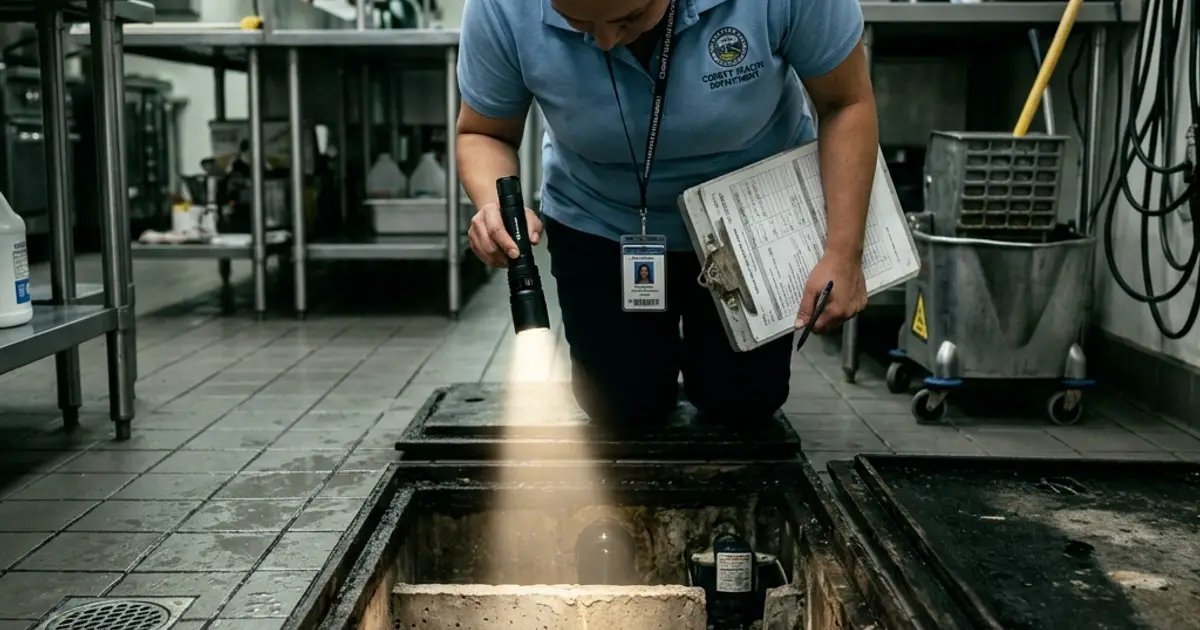
Visual inspection of grease removal equipment: The inspector opens the grease trap or interceptor access point and visually checks the FOG accumulation level.
-
25% rule check: If FOG and solids occupy 25% or more of the trap/interceptor capacity, it's considered overdue for service and is a common failure point.
-
Documentation review: The inspector checks your maintenance records, including pump-out receipts, grease waste manifests, and hauler DEP license verification.
-
Facility walk-through: Some inspectors check kitchen practices — drain screens in place, employee awareness, proper disposal practices, and whether prohibited items are being poured down drains.
-
Written report: You receive a written inspection report noting any violations, required corrections, and deadlines.
Common Reasons for Failing a FOG Inspection
These are the most frequent violations Florida inspectors cite:
Equipment violations:
- Grease trap/interceptor exceeds 25% FOG capacity (needs pumping)
- Damaged or missing baffles inside the trap
- Broken, missing, or improperly sealed lids
- Grease trap not properly connected or bypassed
- Wrong size trap for the establishment's flow rate
Documentation violations:
- No maintenance log or records on-site
- Missing grease waste service manifests (Form 62-705.300(3))
- Cannot verify hauler's DEP license
- Manifests incomplete — missing hauler signature, disposal facility, or dates
- Records not retained for the required period (minimum 1 year on-site)
Operational violations:
- No drain screens or strainers on floor drains and sinks
- Evidence of grease poured directly into drains or dumpster area
- Improper storage of used cooking oil (leaking containers, no secondary containment)
- Employees lack awareness of FOG procedures
Penalty Structure
Penalties for FOG violations in Florida come from two levels:
State Level — Chapter 62-705 F.A.C.
Under the DEP enforcement framework:
- First offense / minor violation: Written warning or notice of violation with correction deadline
- Failure to correct: $100 to $500 per day of non-compliance
- Serious violation (illegal disposal): $1,000 to $5,000 per offense
- Using unlicensed hauler: Separate violation for both the establishment and the hauler
County/Local Level
Many Florida counties impose their own penalties that can be stricter than state minimums:
- Miami-Dade County: $250 first violation, $500 second, up to $1,000 per day for ongoing non-compliance. Can issue sewer service disconnection notice.
- Pinellas County: Civil penalties up to $500/day. Required FOG program enrollment with quarterly inspections for repeat offenders.
- Hillsborough County: Graduated penalty structure starting at $150, escalating to $1,000+ for third offense within 12 months.
Health Department
County health departments can issue separate violations affecting your food service license. Repeated FOG failures may trigger additional health inspections and could jeopardize your operating permit.
Timeline to Correct Violations
After a failed inspection, you typically have:
- Immediate hazard (overflow/backup): 24 to 48 hours — must arrange emergency service
- 25% capacity exceeded: 7 to 14 days to schedule pump-out and provide proof of service
- Missing documentation: 15 to 30 days to produce records or establish a documentation system
- Equipment issues (damaged trap, wrong size): 30 to 90 days depending on scope of repair or replacement
- Re-inspection: Most counties schedule a follow-up inspection within 30 to 60 days
What Inspectors Specifically Check
Be ready for inspectors to verify all of the following:
At the grease trap/interceptor:
- FOG level below 25% of capacity
- Baffles intact and properly positioned
- Lid secure and accessible (not blocked by equipment or storage)
- No visible leaks or structural damage
- Proper ventilation (no trapped gases)
In your records:
- Maintenance log showing service dates and hauler name
- Grease waste manifests (Form 62-705.300(3)) for each pump-out
- Hauler's DEP license number (verifiable)
- At least 1 year of records on-site
- Emergency service records if applicable
In the kitchen:
- Drain screens/strainers in all sinks and floor drains
- "No grease down drains" signage visible to staff
- Used cooking oil stored in sealed containers with secondary containment
- Employee training records for FOG procedures (some counties require this)
How to Prepare for a FOG Inspection
The best way to pass every inspection is to maintain compliance as an ongoing practice, not a last-minute effort:
-
Stick to your pump-out schedule. Don't skip or delay service. If your county requires service every 90 days, schedule it for every 75 days to build in a buffer. Find a reliable service provider in your area.
-
Keep manifests organized. Create a dedicated binder or digital folder. Every pump-out should have a complete manifest with hauler info, disposal facility, volumes, and signatures.
-
Verify your hauler annually. Confirm your hauler's DEP license is current. If they lose their license, you're still liable for using an unlicensed hauler.
-
Train your staff. Ensure every kitchen employee knows the basics: scrape plates before washing, never pour grease down drains, report slow drains immediately. Document this training.
-
Do monthly self-inspections. Check FOG levels, look for leaks, verify drain screens are in place. Log your self-inspections — they demonstrate good faith to county inspectors.
-
Keep the access point clear. Inspectors cannot inspect what they cannot reach. If your interceptor lid is buried under a dumpster or pallet stack, that's an automatic violation in some counties.
Frequently Asked Questions
Will I get shut down for failing one FOG inspection?
Almost never for a first offense. You'll receive a notice of violation with a correction deadline. Shutdowns are reserved for extreme cases — active sewage overflow, repeated non-compliance after multiple warnings, or public health emergencies. However, take every violation seriously, as they escalate quickly. **Can I appeal a FOG inspection failure?** Yes. Most counties have an administrative appeal process. You typically have 10 to 15 days to file a written appeal. However, you should still correct the violation during the appeal period — the appeal addresses the penalty, not the requirement to fix the problem. **How often do FOG inspections happen in Florida?** It depends on your county and your compliance history. Most counties inspect food service establishments annually. Establishments with prior violations may be placed on quarterly inspection schedules. Some counties only inspect upon complaint or during routine sewer system monitoring. **Does a FOG violation show up on my health inspection report?** In some counties, yes. FOG violations reported to the county health department can appear on your public health inspection record. In counties where the health department conducts FOG inspections directly, it's automatically part of your inspection history. Check with your [county's requirements](/county) for specifics.