5 Warning Signs Your Grease Trap Needs Immediate Cleaning
A busy Friday night service is no time to discover your grease trap has been screaming for attention. Yet that is exactly when most Florida restaurant owners find out — when dishes are piling up, water is pooling around the floor drain, and a customer at table six is wrinkling their nose at something that is definitely not on the menu.
Grease traps do not fail without warning. They send signals for days, sometimes weeks, before a full-blown crisis hits. The problem is that kitchen teams are so focused on tickets and table turns that the early signs get written off as "normal." They are not normal. They are your trap telling you that something needs to happen right now.
Here are the five warning signs every Florida restaurant owner and kitchen manager needs to recognize — and what to do the moment you spot them.
1. Slow-Draining Sinks and Floor Drains
What it looks like: Water pools in your three-compartment sink longer than usual. The floor drain near the dishwasher takes minutes instead of seconds to clear. You notice staff stepping around standing water during peak service.
Why it happens: Fats, oils, and grease (FOG) accumulate inside the trap and narrow the passageway that water flows through. As the trap fills, drainage slows progressively. By the time you notice sluggish drains, your trap is likely past the 25% capacity threshold that triggers mandatory cleaning under most Florida county FOG ordinances — including Miami-Dade's well-known DERM program.
What to do immediately: Stop pouring any additional grease down the drain. Check the last date on your grease waste service manifest. If your next scheduled pump-out is more than a week away, call your hauler and request an early service. Slow drains only get worse, never better, without intervention.
2. Foul Odors Coming From Drains or the Trap Area
What it looks like: A rotten, sour smell that intensifies in warm weather. Staff may describe it as sewage, rotten eggs, or spoiled food. The odor tends to be strongest near the grease trap access point, but it can migrate through the entire kitchen ventilation system.
Why it happens: When FOG sits in a trap too long, it decomposes. Anaerobic bacteria break down the accumulated grease and food solids, producing hydrogen sulfide and other sulfur compounds. The warmer the environment — and Florida kitchens are warm year-round — the faster decomposition accelerates. This is not just unpleasant; hydrogen sulfide is corrosive and can damage metal trap components over time.
What to do immediately: Do not mask the smell with bleach or deodorizers poured into the drain. Chemical additives can push grease further into the sewer line and create a bigger problem downstream. Instead, schedule a cleaning within 48 hours. If the smell is severe enough that customers can detect it in the dining area, treat it as an emergency — a health inspector who walks in during that window will notice too. Learn more about how grease trap maintenance affects your health inspection score.
3. Grease Visible in Drain Water
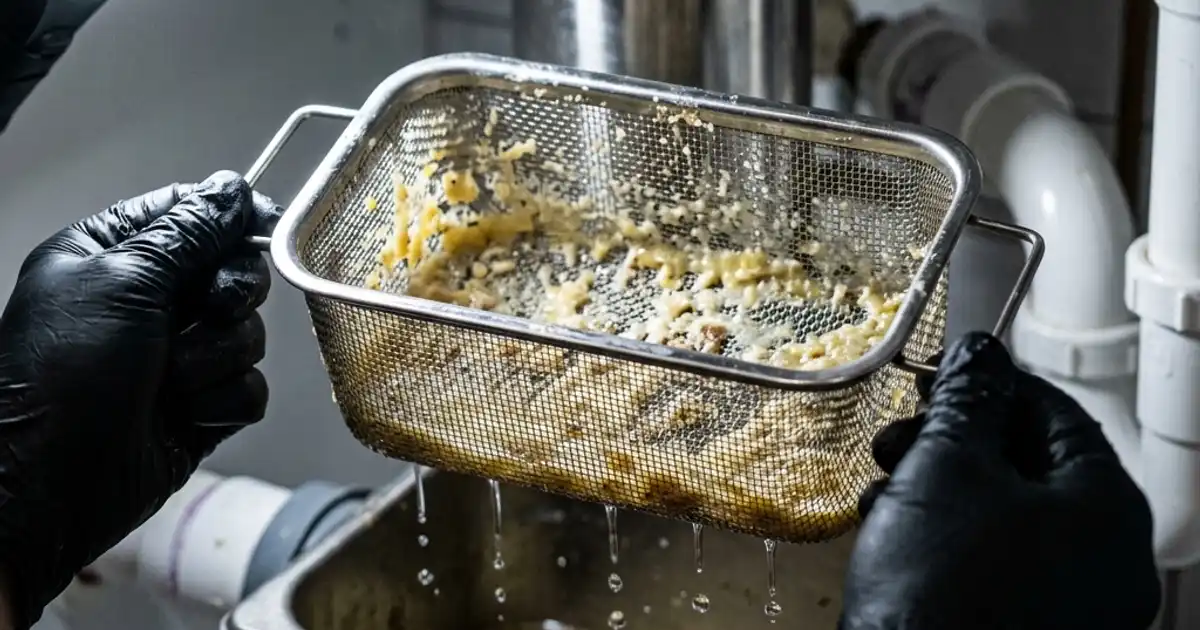
What it looks like: You see a greasy film, floating globs, or a yellowish sheen on the surface of water in sinks, floor drains, or around the grease trap lid. Sometimes grease appears in the dishwasher drain line or backs up into hand-washing sinks.
Why it happens: Your grease trap works by slowing water flow so FOG floats to the top and solids settle to the bottom, allowing relatively clean water to exit through the outlet. When the trap is full, there is nowhere for new grease to separate — so it passes straight through, visibly contaminating outgoing water. This is also the point at which your facility starts sending FOG into the municipal sewer system, which can trigger violations from your local utility.
What to do immediately: This is a compliance red flag. Under Chapter 62-705 F.A.C., grease waste originators are responsible for ensuring their traps function properly. Visible grease in drain water means your trap is not functioning. Call your licensed hauler for same-day or next-day service. Document what you observe with photos and timestamps — if the county follows up, you want to show you acted promptly.
4. Frequent Drain Backups
What it looks like: Water reverses direction and comes back up through floor drains or sink drains. In severe cases, wastewater floods the kitchen floor. Backups may start intermittently — once a week, then every few days — before becoming a daily occurrence.
Why it happens: A grease trap that has exceeded capacity creates a blockage in the drainage system. Water has nowhere to go, so it takes the path of least resistance — back up into your kitchen. Backups can also indicate that the outlet pipe from the trap to the sewer is clogged with hardened grease, which happens when regular cleaning is deferred too long.
What to do immediately: Stop all water use in the affected area. A backup is a health hazard — contaminated water on your kitchen floor can trigger an immediate shutdown during an inspection. Contact your grease trap service provider for emergency service. Many Florida grease trap companies offer 24/7 emergency response for exactly this situation. After the backup is cleared, ask your hauler to inspect the outlet line. You may need hydro jetting to clear hardened deposits that regular pumping cannot reach.
5. You Have Not Cleaned in 90+ Days (or Cannot Remember the Last Cleaning)
What it looks like: There is no recent manifest on file, and no one on staff can recall the last time the trap was serviced. The cleaning log on the wall has not been updated in months.
Why it happens: In the daily chaos of running a restaurant, grease trap maintenance falls off the radar. There is no dramatic event that reminds you — until one of the four signs above appears. Florida counties set specific cleaning frequencies: Hillsborough County requires service every 90 days, Sarasota County mandates 30 days for interior traps, and Pinellas County requires monthly service for grease interceptors. If you are past your county's deadline, you are already out of compliance.
What to do immediately: Check your records. Under Chapter 62-705, both the originator (you) and the hauler must maintain manifests for five years. If you have no manifest for the last service, you have a documentation gap that an inspector will flag. Schedule a cleaning today — not next week, today. Then set up a recurring service contract with a licensed hauler in your county so this never happens again. A contract with automatic scheduling is the single most effective way to stay compliant without relying on memory.
The Cost of Ignoring These Signs
A routine grease trap pump-out in Florida costs between $200 and $500 depending on trap size, location, and frequency. An emergency service call after a backup can run $500 to $1,500 or more — and that does not include the cost of lost business during a kitchen shutdown.
Health code violations related to grease traps can result in point deductions on your inspection score, and repeated violations can escalate to fines ranging from $100 to $5,000 under Florida's penalty structure. In extreme cases, chronic non-compliance can lead to a temporary operating permit suspension.
The math is simple: proactive maintenance costs a fraction of reactive emergency service. Every one of these five warning signs is your grease trap giving you a chance to handle things on your terms, on your schedule, at regular pricing.
What to Do Right Now
If you recognized any of these signs in your kitchen, take action today:
- Check your last manifest date — is it within your county's required frequency?
- Find a licensed hauler — browse the Florida grease trap service directory to find providers in your area
- Set up a recurring contract — eliminate the guesswork and ensure you never miss a cleaning
- Review your compliance status — use our compliance resources to understand your county's specific requirements
Do not wait for sign number four or five. By then, you are paying emergency rates and hoping an inspector does not walk in first.
Frequently Asked Questions
How often should a restaurant grease trap be cleaned in Florida? It depends on your county and trap size. Most Florida counties require cleaning every 30 to 90 days. Miami-Dade uses the 25% capacity rule, Hillsborough requires every 90 days, and Sarasota mandates every 30 days for interior traps. Check your county's specific requirements or ask your hauler to recommend a schedule based on your kitchen's volume.
Can I clean my own grease trap instead of hiring a hauler? You can perform basic maintenance like scraping and skimming between professional cleanings, but the actual pump-out and disposal of grease waste must be performed by a DEP-licensed hauler under Chapter 62-705. Improper disposal of grease waste carries significant fines. See our guide on how to verify your hauler is DEP licensed.
What happens if a health inspector finds my grease trap overflowing? An overflowing or non-functional grease trap is a critical violation in most Florida county health inspection frameworks. It can result in immediate point deductions, a required re-inspection, and potential fines. In severe cases, an inspector can require you to cease operations until the trap is serviced. Read more about how grease trap maintenance affects your health inspection score.
Frequently Asked Questions
How often should a restaurant grease trap be cleaned in Florida?
It depends on your county and trap size. Most Florida counties require cleaning every 30 to 90 days. Miami-Dade uses the 25% capacity rule, Hillsborough requires every 90 days, and Sarasota mandates every 30 days for interior traps. Check your [county's specific requirements](/compliance) or ask your hauler to recommend a schedule based on your kitchen's volume. **Can I clean my own grease trap instead of hiring a hauler?** You can perform basic maintenance like scraping and skimming between professional cleanings, but the actual pump-out and disposal of grease waste must be performed by a DEP-licensed hauler under Chapter 62-705. Improper disposal of grease waste carries significant fines. See our guide on [how to verify your hauler is DEP licensed](/guides/verify-grease-hauler-dep-licensed). **What happens if a health inspector finds my grease trap overflowing?** An overflowing or non-functional grease trap is a critical violation in most Florida county health inspection frameworks. It can result in immediate point deductions, a required re-inspection, and potential fines. In severe cases, an inspector can require you to cease operations until the trap is serviced. Read more about [how grease trap maintenance affects your health inspection score](/blog/grease-trap-maintenance-health-inspection).